
- About us
- SolutionsCoaching Solutions
- Facilitators
- Resources
- Contact us
India’s Global Capability Centers (GCCs) have accomplished something remarkable. In just three decades, they have built what is now the world’s foremost capability ecosystem – home to over 1,800 GCCs, 1.9 million professionals, and $64.6 billion in revenue in FY2024, representing nearly 45% of the global GCC talent base. The sector is projected to reach $99–110 billion and host 2.5–2.8 million employees by 2030.
Today, GCCs face a crucial strategic inflexion point. Moving beyond traditional labor cost arbitrage requires GCC Site Heads, Country Leaders, and Functional Executives to re-architect their operating models to drive co-innovation, top-line growth, and global enterprise influence.
Access the full diagnostic self-assessment tool to benchmark your organization’s enablers, identify silent value destroyers, and evaluate your HQ alignment.
To ensure competitiveness and drive sustainable business relevance, GCC leaders India must navigate through five core paradigm shifts:

Shifting from FTE efficiency and cost savings to owning end-to-end product delivery, global innovation, and business margin growth.
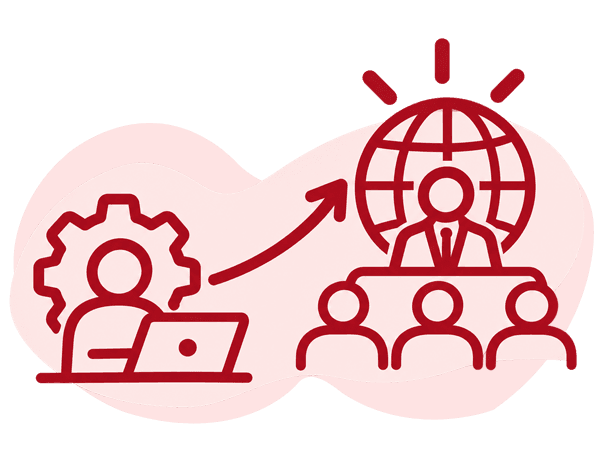
Positioning GCC executives as trusted co-owners of global enterprise strategy rather than downstream execution managers.

Evolving vendor-style, transactional internal customer relationships into high-trust strategic partnerships with HQ.

Building a compelling regional Employee Value Proposition (EVP) that attracts high-caliber leaders through global career pathways.

Mitigating burnout, shift fatigue, and high attrition by cultivating human-centered, resilient GCC leadership capabilities.
Enterprise value in a GCC context is not created by execution volume alone. It emerges when global centers operate as trusted partners co-creating capability, innovation, and long-term vitality for the entire enterprise.
The EVA framework aligns leader mindset with organizational systems to enable continuous, multi-dimensional value flow:

Deepening GCC leadership bench strength, protecting psychological vitality, reducing attrition in niche technical roles, and offering cross-border mobility.

Driving sustainable IT infrastructure, energy-efficient facility operations, green data strategies, and impactful local community initiatives.

Delivering tangible bottom-line efficiencies, direct revenue support, continuous process innovation, and strategic IP creation.

Unifying distributed teams across regions, bridging cultural gaps with HQ, and fostering ethical governance across matrix organizations.
This framework evaluates operational enablers and discovers unseen high-value destroyers across various dimensions:

GCC budgets fund high-impact R&D; scorecards capture global revenue contribution and margin expansion.
Solely tracked as a cost-plus center; rigid headcount-focused metrics prioritized over outcome delivery.

Dedicated innovation pods and hackathons; global patent and process IP filing frameworks.
Disbanding innovation initiatives at the first sign of margin pressure; multi-tier HQ approval loops.

Tailored regional EVPs; rotational GCC leadership programs and executive coaching for local leads.
High turnover in critical tech roles; shift-work burnout treated as an individual weakness.

Tracked HQ NPS scores; joint steering committees with global Business Unit heads.
Transactional SLA mindsets without strategic, peer-level dialogues.

Clear matrix decision rights between HQ and local leads; transparent risk and compliance reporting.
Ambiguous local authority; compliance treated purely as a tick-box documentation exercise.
Transitioning from cost-plus accounting to revenue-linked scorecards enables GCCs to co-own enterprise OKRs, directly driving margin growth, optimizing R&D capital expenditure via Centers of Excellence (CoEs), and accelerating time-to-market.
Standardizing cross-border compliance, data privacy, and risk governance minimizes regulatory exposure while eliminating costly re-work, hand-off friction, and cross-time-zone bottlenecks.
Establishing clear career pathways and mitigating shift burnout protects critical technical expertise, drastically cutting attrition costs while boosting global patent filings and proprietary IP creation.
Bridging regional and HQ culture builds high-trust executive partnerships and embeds energy-efficient IT practices directly into the parent enterprise’s global ESG targets.
Map HQ-GCC value flows, evaluate internal service friction, and run cross-border listening sessions. (Deliverable: GCC Enterprise Value Map)
Co-design service models with HQ, redesign governance loops, and align senior regional leaders. (Deliverable: GCC EVA Blueprint)
Deploy executive immersion programs, launch regional EVP strategies, and drive cultural alignment. (Deliverable: Execution Roadmap)
Establish joint quarterly value reviews with HQ, monitor impact metrics, and build sustainable local leadership pipelines. (Deliverable: GCC Value Maturity Index)
Connect with our GCC Practice Partners for a 45-minute strategic session to map your center’s current maturity and explore high-impact value levers.
Access the full diagnostic self-assessment tool to benchmark your organization’s enablers, identify silent value destroyers, and evaluate your HQ alignment.
The evolution from an operational delivery hub to a recognized global value engine is not merely a structural change, it is a leadership shift. By embedding Pragati Leadership’s EVA and EVD frameworks into your operating model, GCC middle management and leaders can systematically eliminate operational friction, build resilient regional talent ecosystems, and secure true board-level influence.
Align your GCC’s talent, governance, and operational vision with global enterprise strategy to turn capability into your strongest competitive advantage.
It is tailored for GCC Site Heads, Country Leaders, Functional Executives, and GCC middle management who are responsible for evolving India-based Global Capability Centers from execution hubs into strategic value-creation engines.
GCC leaders operate at a unique strategic inflection point—transitioning away from traditional labor cost arbitrage and downstream execution toward co-innovation, top-line growth, and global enterprise influence. A generic approach does not address cross-border matrix complexities, cultural gaps with global HQ, shift-fatigue burnout, or moving from vendor-style SLAs to high-trust strategic partnerships.
Unlike conventional programs that focus primarily on general management skills and internal operational delivery, this program uses specialized frameworks (like the EVA Philosophy and GCC Enterprise Value Diagnostic) to help leaders navigate five specific core paradigm shifts:
The program develops capabilities organized around the four EVA pillars:
Yes. Through its Innovation & Learning Value and Planet dimensions, the program equips leaders to set up innovation pods/hackathons, streamline patent/process IP frameworks, and build green data strategies and sustainable IT infrastructure to support digital transformation.
Pragati Leadership uses a proprietary 4-stage transformation roadmap (Discover, Architect, Activate, Evolve) powered by two distinct tools:
ROI and performance shifts are tracked through specific quantitative metrics evaluated via the GCC Enterprise Value Diagnostic (EVD) and the GCC Value Maturity Index:
The program is structured as a multi-stage organizational transformation journey rather than a one-time workshop: