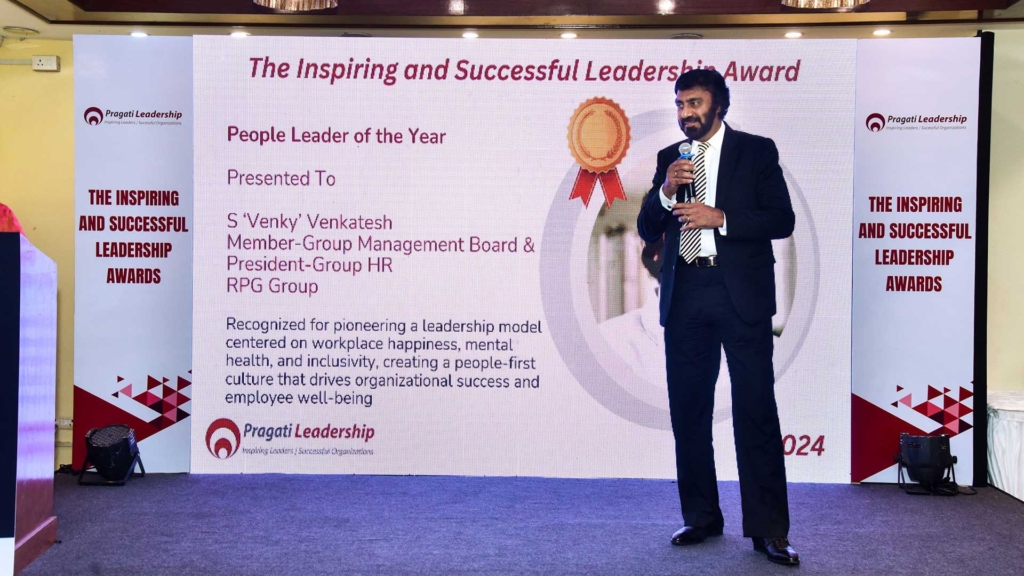
We celebrate S. ‘Venky’ Venkatesh, a pioneer in redefining leadership by placing workplace happiness, mental health, and inclusivity at the core of corporate success.
Pragati Leadership’s undiluted focus is on making highly relevant corporate leadership development programs available to aspiring leaders across industries. In the 30-plus years of our existence, we have tailored some of the best CEO training programs, people management training programs, and leadership coaching for women, among others. As we continue to widen the ambit and accessibility of our programs, we also set up a series of awards that would offer credible success stories for our trainees to learn from and emulate. The Inspiring & Successful Leadership Awards, first given out in 2022, are our way of saluting dynamic corporate heroes who are known to deliver positive outcomes for their organizations as well as the people with whom they work.
For pioneering a leadership model centered on workplace happiness, mental health, and inclusivity, and creating a people-first culture that drives organizational success and employee well-being, S ‘Venky’ Venkatesh (Member-Group Management Board and President-Group HR,
RPG Group) received the People Leader of the Year award as part of the Inspiring & Successful Leadership Awards 2024.
S ‘Venky’ Venkatesh is proving that prioritizing employee happiness is essential for business conglomerates. He is redefining leadership and using a proprietary happiness quotient framework to guide policies and initiatives from championing mental health to creating inclusive, safe workplaces. Mr. Venkatesh’s approach ensures that employee well-being is not just a goal, it is at the heart of a conglomerate’s success. His HR career of nearly 4 decades spans several crucial leadership roles in different industries.
A Leadership Model Built on Happiness
Mr. Venkatesh spoke of looking up to accomplished leaders like Mr. Arun Wakhlu of Pragati Leadership as a rookie, which made receiving the award an honor for him. He went on to accept the award “with due humility, on behalf of the 40,000 RPGians” who are the lifeblood of the RPG group and who motivate people like him to do something different and better. He recalled their effort to recast their vision statement some years ago when they came up with a four-part vision statement.
The last part read “Be Happy” and included a smiley emoji, making them possibly the only organization in the world with such an emoji in their vision statement. He expanded that their tagline is Hello Happiness, which people said was too cheesy and asked what it meant. The tagline drew comparisons with soft drink companies that said when you open a bottle of their drink, you uncork happiness.
What followed, he recounted, was a deep dive into what the people at RPG Group had in mind when they said that they wanted a happy workplace. They used a technology familiar to HR folks called employee insighting, borrowed from the customer insighting used in marketing. About 10,000 of the 40,000 RPG people participated in the survey, which included three hundred deep insighting conversations with leaders. Mr. Venkatesh remembered having the conversation with the RPG Group Chairman – and his boss – Mr. Harsh Goenka. He added that they consider this proprietary tool their intellectual property as, in their view, no company of their scale used happiness as a primary means of employee engagement. For them, however, happiness is both a means and an end and, therefore, a vital part of their existence.
RPG Group, Mr. Venkatesh elaborated, moved away from the plain vanilla employee and engagement surveys that many reputable companies undertook. These surveys, typically comprising existential questions, did not work for them beyond a point. They went beyond to seek answers to questions like would you work for this company if it did not pay you the highest salary in the market, or if the career growth was a little slower? He clarified that they did not “hide behind happiness” and deny their people these aspects.
From the responses, they found that people wanted a far more fulfilling organization and a balanced existence wherein they could get most things. In every company, reflected Mr. Venkatesh, people might get a promotion or a phenomenal salary, but lack many other things or there may be politics. They genuinely tried to make RPG a happy organization, he opined, by doing multiple things.
Leading the Way with Hybrid Work Models
He gave the example of how they were among the first companies to launch a hybrid working model even at the peak of the pandemic, in September 2020. Going from working completely remotely because of the then-ongoing COVID-19 pandemic, they subsequently adopted the hybrid work policy, which they continue to follow until today, even in a predominantly brick-and-mortar organization.
He also noted that the RPG Group IT services company Zensar had taken this policy to another extreme. At one time, he recollected, they had people working in three hubs: Pune, Hyderabad, and Bangalore. Today, they work out of 600 locations and the company has no intentions of calling them back to the hubs, despite having, for instance, a huge campus in Kharadi in Pune which they do not know how to fill up. That, Mr. Venkatesh hypothecated, was a different problem.
He highlighted that they provided work from home even for factory employees by defining the work-from-home entitlement as depending on a person’s job rather than their industry or sector, e.g. IT sector or financial services. A purchase person or a quality person not employed on the shop floor and not running a machine was, effectively, in an administrative building within a factory and could work from home, Mr. Venkatesh illustrated. In doing so, he felt they had deprivileged a corporate-employees-only culture and made it far more egalitarian.
Driving Meaningful Social Change Through DEI
Another responsibility for leaders creating a happy workplace was ensuring that they did not have unhappiness creeping in. At RPG Group, they had espoused a strong, constantly present anti-harassment “overhang”, which surpassed following legal norms like conducting Prevention of Sexual Harassment (POSH) workshops. He elucidated that they took cognizance of and strong action against any kind of harassment charge, whether based on caste, religion, language, or region where people came from – particularly Northeastern India – or even making comments in a language other people did not understand as they were now present across 150 countries.
Listing some examples of actions taken from a social good perspective, Mr. Venkatesh narrated how their DEI chapter did have the usual LGBTQ hiring agenda but also involved hiring transgender people begging on the streets and placing them in manufacturing locations. He surmised that they and Tata Steel – “a great organization doing wonderful work in this area” – have undertaken this initiative well. However, he saw it as part of a social good agenda rather than a DEI agenda, which contributed to happiness.
Reminiscing on the experience, he said that the group hired to work in their Bhandup plant had run away after the first week. They had reconnected with them through the NGO with whom they were working to find out why they had left a respectable job with a great salary. The response was that it was too much work and that they could make what they were paid for eight hours of work in one hour of begging.
This interaction led to Mr. Venkatesh and his team realizing they had not done enough to convince the transgender hires that begging should not be their lifelong existence. As a result, they were now striving to hire transgender workers in every manufacturing plant alongside implementing their regular LGBTQ hiring policies. Another example cited by Mr. Venkatesh as being unique in the Indian corporate context was extending health and other benefits to unmarried partners of their heterosexual employees. These actions underlined how they did not have just a Friday evening pizza concept of happiness. Instead, according to Mr. Venkatesh, they wanted to ensure they did things meaningful to their employees every day.
He felt they tried to practice this among the HR Community at RPG Group. For him, personally, a lot of these practices stemmed from his experience at previous organizations, which believed in the Total People Championship model. Mr. Venkatesh appealed to his younger HR colleagues to exceed their remit as their profession, in his view, was a calling. While they would always face pressure to fulfill what the business requires, there were few professions in which they could do much more than what was necessary.
He also cautioned that it would stretch them and they would constantly be on the roller coaster of stress but the effort would be worth it because it would impact thousands of people in the organization. This kind of impact, he concluded, was unavailable to most leaders, even accounting for the impact CEOs could have, and once again thanked “the thousands and thousands of employees” who had inspired him more than his bosses to do something right for them.
Speak to a Pragati Leadership expert for corporate leadership development programs tailored to your specific objectives.